


Recognizing the Realities
To be a Black family navigating family-building often means making deeply personal decisions while navigating systems that weren’t designed with your story in mind. It means dreaming of parenthood while facing layered financial, cultural, and systemic barriers. These barriers may be invisible to others but are all too familiar within Black communities. Family-building is not one-size-fits-all, and for Black families, it is often an act of quiet resilience.
Equitable benefits must account for these disparities, ensuring all employees feel supported at every stage.
When workplace benefits fail to account for the lived experiences of Black employees, it’s not just oversight. It’s exclusion.
Building Legacies, Facing Barriers
Black families have always built powerful legacies through love, resilience, and deep-rooted community care. Racial wealth disparities across the U.S. continue to shape which family-building paths are within reach. When journeys like adoption or surrogacy cost $35,000 to $200,000, the impact of systemic inequities becomes impossible to ignore. That gap isn’t just statistical…..it’s a brick wall.

Even home studies, legal fees, and agency retainers come with price tags that many can’t meet alone. The dream of parenthood is there. The path to get there, though, can feel out of reach.
Black families are underrepresented in these paths—not due to lack of desire, but because cost remains one of the greatest barriers. And still, Black families continue to rise for children in extraordinary ways. Over 2.5 million children in the U.S. are being raised by relatives or close family friends. Many of those families are Black. Many are navigating it without support.
For Black individuals and couples, this means delaying parenthood, taking on extensive debt, or stepping away from the dream completely, not because they lack desire or commitment, but because the system was not built to include them.
The question is NOT whether Black families want to grow and care for children. The question is: Are we removing the cost barriers that make it possible for them to do so?
When Benefits Don’t Account for Barriers, They Become One
When employers offer family-building benefits, they often focus on blanket reimbursement or IVF-only plans. But real equity means asking deeper questions:

Most benefit programs weren’t designed for people who carry generational financial trauma or who may be the first in their family with corporate access. That’s not an indictment. It’s an invitation to do better.
When benefits fail to account for these realities, the impact shows up in ways many employers never track:
- Employees delaying family-building because they can’t afford the upfront costs.
- Workers taking on second jobs or high-interest loans just to start the process.
- Missed opportunities for employers to improve DEI outcomes through inclusive benefits.
- Low utilization rates among BIPOC employees due to a lack of access.
- Emotional burnout, disengagement, or silent resignation from employees who feel unseen.
Family-building support shouldn’t only benefit those who already have wealth. It should uplift those who’ve historically been left out of the conversation.
Representation Shapes Access and Belonging
Representation in family-building is about access, trust, and psychological safety. When Black families are left out of the picture, literally and figuratively, it sends a quiet message: This path isn’t for you.
What this looks like in real life:
- Black adoptive parents are often missing from agency marketing and training materials.
- Black gestational carriers and egg donors are underrepresented, and often face harmful stereotypes.
- Black LGBTQ+ families encounter intersecting barriers at every stage of the journey.
When workplace benefits and vendor platforms mirror these same gaps, by failing to name or address them, it reinforces inequity. Representation is not optics. It’s infrastructure.
What employers can do:
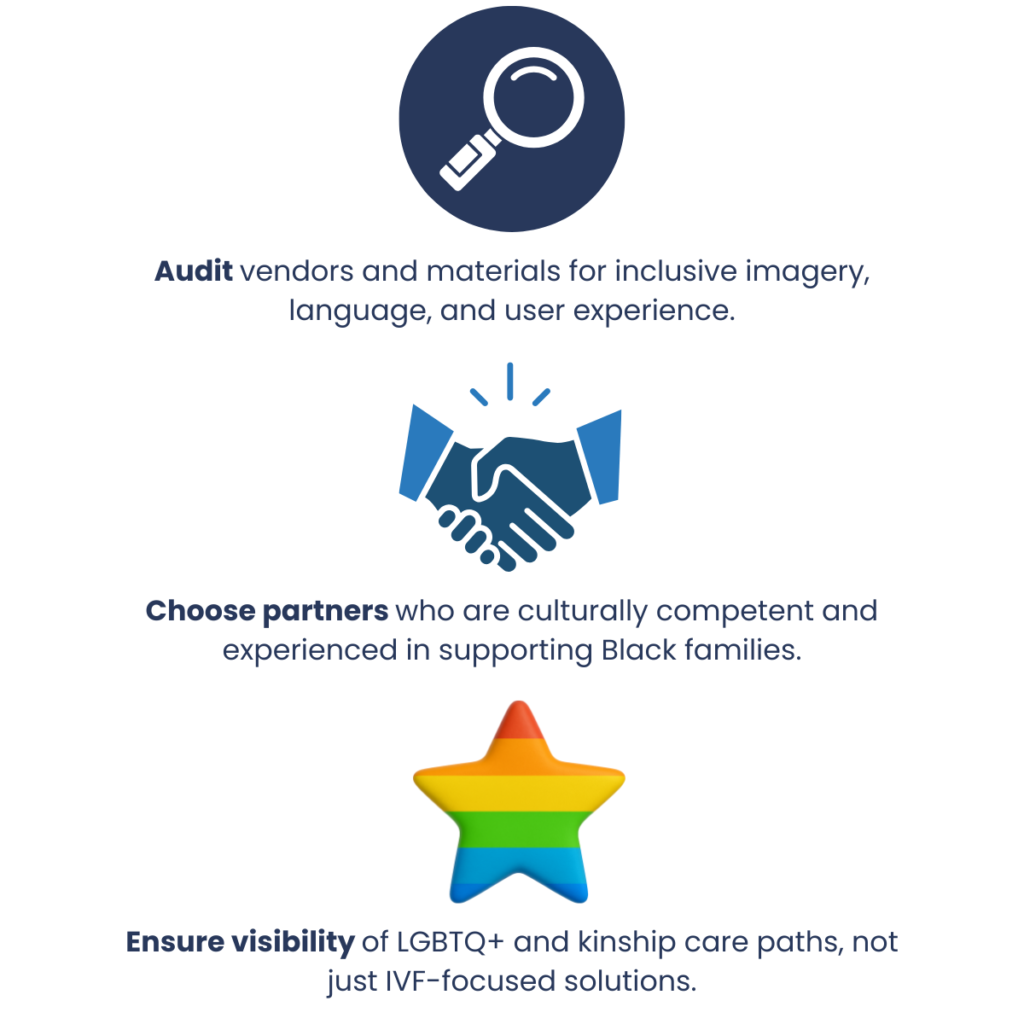
Cultural sensitivity isn’t about checking a box. It’s about rewriting the story of who belongs in parenthood, and making sure every employee sees themselves in it.
What Real Inclusion Looks Like
Equity in family-building isn’t a concept. It’s a commitment, and it shows up in the details of your benefits program.
What real inclusion means in practice:
- Upfront financial assistance — not just reimbursement after-the-fact.
- Financial coaching and grant navigation tailored to BIPOC employees.
- Support for kinship, adoption, and non-clinical paths, which many Black families rely on.
- Partner and single-parent support that doesn’t assume one family model.
- Recognition of informal caregiving, with resources that don’t penalize families for choosing culturally rooted support systems.
- Culturally competent resources with inclusive language and representation across benefits materials, providers, and partner platforms.
- Affirming mental health and coaching support, to build trust and provide emotional safety throughout the journey.
And just as important: If your benefits are buried in fine print or hidden in IVF-only portals, they’re not accessible. Visibility is equity.
The Power of Policy to Change Futures
For many Black employees benefits are possibilities; they’re lifelines.
When employers design inclusive policies that reduce financial barriers, offer trusted support, and reflect the lived experiences of Black families, the impact is generational.
These policies say:
We see you.
You belong.
You’re not alone on this journey.

Equality gives everyone the same starting point. Equity ensures everyone has a path forward.
This February, as we honor Black History Month, we invite HR leaders and brokers to reflect on how equitable family-building benefits can rewrite the narrative for more families.
